
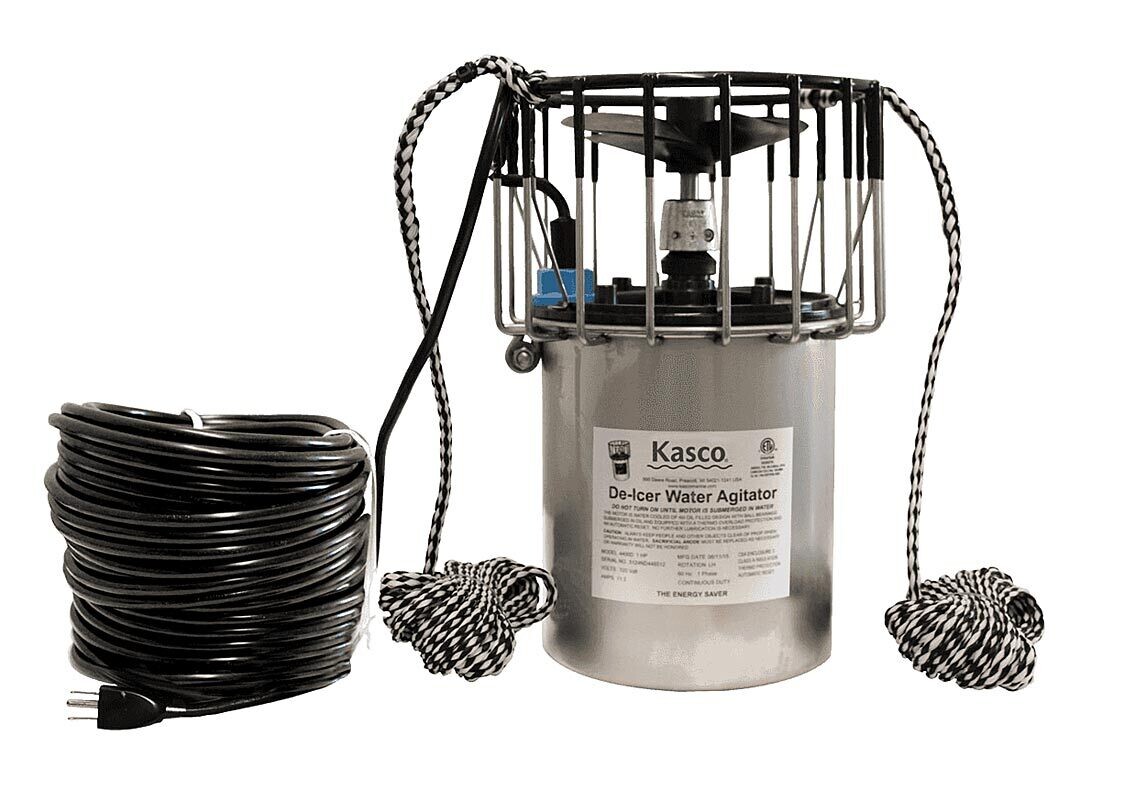
Kasco 1 HP Dock De-Icer
In the winter months, Kasco De-Icers can be used to keep areas of water open by pushing warmer water up to the surface to prevent freezing, keeping boats and docks safe from damaging ice buildup.
Kasco’s De-icers create more thrust than any other product on the market. More thrust means more open water to better protect your property.
Not only do De-icers protect your in-water property, they also help keep fish and aquatic species healthy throughout the winter by allowing for open areas where oxygen can enter the water to help prevent winterkill on fish populations. Kasco de-icers come with (2) 20 ft. suspension ropes and are available in 1/2, 3/4, and 1 HP unit sizes. Use de-icers year-round for improved health and beauty of your water.
A Kasco De-icer will mix the water and move warmer, bottom water to the surface to keep an area of the pond open. Only 1% of the ponds total surface area needs to be ice free to prevent winter-kill situations. The cold water will become oxygenated by coming in contact with the air and prevent winter-kill on your pond.
Kasco De-icers positioned around docks and/or boats can prevent costly ice damage by keeping an area ice free around your valuables. Depending on your situation, they can be mounted in different ways.
Includes:
Features:
Specifications:
Gill Flukes (Dactylogyrus sp.) are found on fishes’ gills as well as their skin, where they feed on blood and mucous. They can lay up to 20 eggs per hour!
Body flukes (Gyrodactylus sp.) are a fairly common parasite found on pond fish. They do not lay eggs like gill flukes, instead they produce live young. They are found both on the gills and the body of fish.
Covering 50%-65% of your pond’s surface with plants is recommended to help shade the pond and keep the water cool in the summer months. Plants also consume excess nutrients from the water reducing algae growth and help to maintain optimal water quality. These 'Clear Water Plants' are some of the best plants for maintaining a clear, healthy pond.
If you plan to keep koi in your pond, it should be at least 4’ deep to give them enough space to swim and develop properly.
The beautiful koi we see today originally started out as bland coloured carp that were raised for food in Japan. It wasn’t until the early 1800's when farmers began to notice interestingly coloured fish appearing in their rice paddies and began selectively bred for colour.
Although algae can be a pond owners worst problem, it has many potential benefits outside of the pond such as, a source for biofuels, fertilizers and nutritional supplements
Nualgi is a product that natural fights algae in your pond. Nualgi provides essential nutrients promote a diatom bloom. These invisible diatoms outcompete the algae in your pond for the nutrients they feed on. The algae soon starves causing the water to clear.
Most water lilies need at least 6 hours of direct sunlight a day to bloom, however there are some Shade Tolerant Water Lilies that will perform well in more shade and bloom quite well.
Costia is common microscopic parasite that is active in cool water. They are smaller than most parasites and are shaped like a comma when viewed under a microscope.
Performing regular, parial water changes is a great way to maintain optimal water quality. Changing 10%-15% of the pond water every week or 2, helps to flush out nitrates, tannins and other waste products while replenishing essential minerals.
Koi make wonderful pets for larger ponds. Because they can often grow up to 24” / 60 cm long (or even larger), they are not well suited to small ponds. Ideally, your pond should be a minimum of 48” / 122 cm deep to adequately house koi.
Pond Flocculants help to clear cloudy water by clumping small particles together so they can be trapped by your filter.
Frog and toad tadpoles are wonderful additions to ponds. Not only is it fun to watch them develop from tadpole to frog or toad, but they also consume copious amounts of algae