
When first designing and building a pond, most people focus on the look and style of the pond, the approximate size and dimensions, the type of stone they want to use etc. Calculating the pond volume accurately isn’t always the first thing on the list they consider.
Sometimes, people buy a house that already has an existing pond. In this case it can be even more difficult to determine the volume because they most likely have no idea how deep the pond really is.
While it is easier to take the measurements of the pond and calculate the volume before filling it with water, it is really hard to fight the urge to get water in the pond as soon as possible. Even so, if the pond has shelves, areas with different depths, sloping sides or a unique shape, it makes it difficult to really get precise measurements to be able to get an accurate volume.
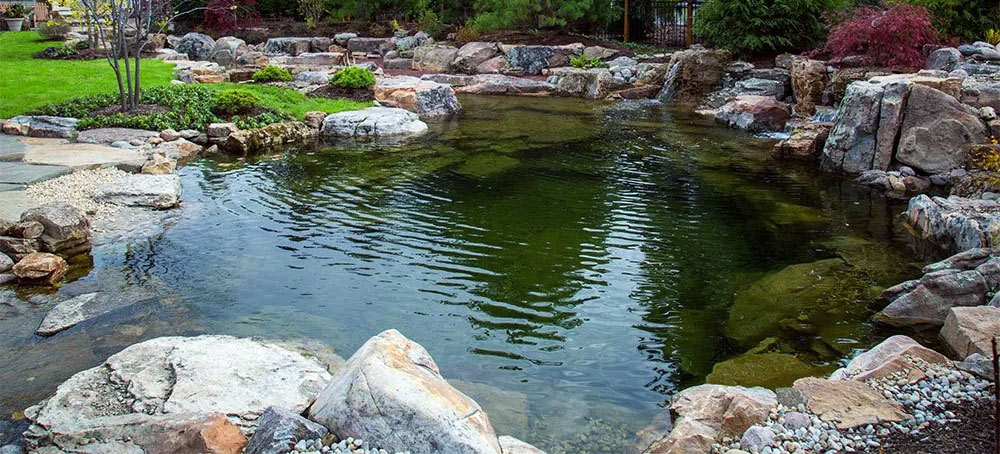
Soon after your pond is completed, you will likely need to add some sort of treatment or additive to the water. But in order to add the correct amount of treatment, you will need to know your pond’s volume.
One common treatment added to ponds is beneficial bacteria to help seed the biological filter and help establish and maintain good water quality. When adding natural treatments like beneficial bacteria or barley extract etc., you don’t really have to be too exact with the dosage, since overdosing the pond will not cause any real problems. Even if you double dose with these natural products, it’s not going to harm your fish or other pond wildlife.
However, when treating with stronger additives such as algaecides or fish medications, you need to be more precise with the dosage, so it is very important to accurately know the volume of your pond. Overdosing with chemical additives or medications is quite dangerous and can easily lead to fish deaths.
If you want a way to accurately determine the volume of your pond even if you don’t know the exact dimensions, there is way – using salt. By adding salt to your pond and then measuring the change in salinity, you can get a very accurate volume. Salinity is simply the concentration of salts dissolved in water.
You might be thinking, why would I use salt in my pond? Actually, salt has many benefits, it kills many common fish parasites commonly found in the pond, it reduces the effects of nitrite toxicity, it stimulates the fish’s slime coat production and many other things. For more information see our Pond Salt – Uses & Benefits page.
For this to work properly you need to add quite a bit of salt. Most people find it to be a surprisingly large amount of salt – but don’t worry it only seems like a lot of salt. We’ve been using salt in our ponds and koi systems for over 25 years, it’s very safe and is actually very beneficial for koi and goldfish.
When you are ready to begin, I would recommend adding about 1 lb of salt per 100 gallons of pond water. This will cause a large enough increase in the salinity to get a good reading. If you think you have roughly 1500 gallons in your pond, you should add 15 lbs of salt. This may seem like a lot of salt, but it will really only raise the salinity slightly. If you compare this to seawater, you would need to add about 25 pounds of salt per 100 gallons of water.
Any non-iodized, untreated sodium chloride (NaCl) salt can be used in pond (or aquariums). Rock salt, solar salt, even ice melting salt can be used as long as it has no additives. Most water softener salt has anti-caking agents in them and should not be used.
If you know the approximate dimensions of your pond you can plug them into out Pond Volume Calculator. You don’t need to be exact with the measurement, you just want to be relatively close. To calculate the volume of your pond you need to know the average length (L), the average width (W) and the average depth (D). Plug these values into this formula L x W x D x 7.48 = US Gallons
A digital salinity tester is the best way to measure how much salt is in your pond. We recommend a couple different models, you can see them at the bottom of the page.
Salinity testers are the best way to measure the salt content of your pond. They have many benefits over other other methods to determine salinity.
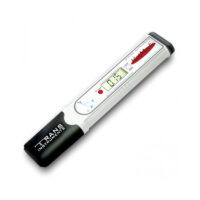
The Koi Medic Salinity Tester is designed to measure the delicate salt concentration in ponds. It provides quick, accurate results and is very easy to use, simply turn on and hold in the pond. Measures accurately from .01% to 1%. It’s also Waterproof!
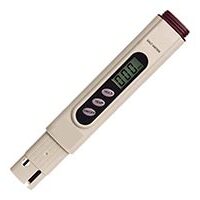
The Economy Pond Salt Tester provides accurate results and is easy to use, simply turn on and hold in the pond. The handy ‘Hold’ button will hold the reading on the screen once removed from the water. Measures accurately from 0 to 9990 ppm.