
Being able to interact with the fish in your pond can be very rewarding. If you would like to train your pond fish to eat from your hand, it really isn’t that difficult, it just takes some practice and patience, and the results can be every entertaining. Hand feeding your koi or goldfish is not only great fun but can be very useful for getting close enough to the fish to allow you to inspect them for signs of injury or disease and monitor their health.
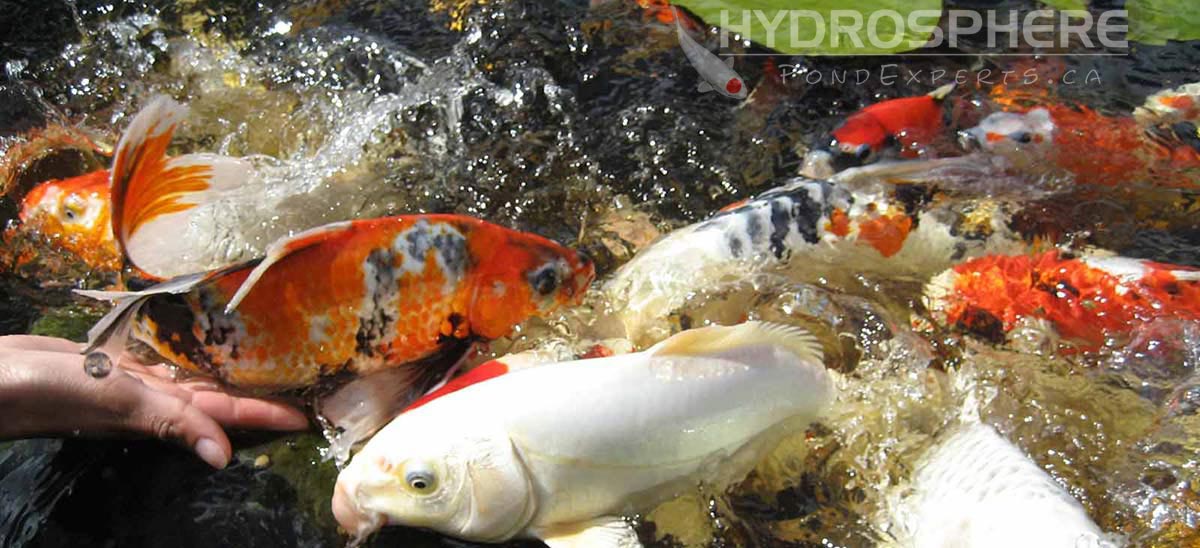

Sometimes fish are very timid and don’t even come to the surface of the pond when you feed them. This makes it more difficult to train your pond fish to eat from your hand. In this case it will take more time to achieve your goal, but it can still be done. In this case, adding one or two new fish to the pond can often change the behaviour of the timid fish. It only takes one ‘brave’ fish to act as the leader – the rest are sure to follow.
If your fish fit this description and are very timid, initially keep your distance from the pond when feeding. Start by standing a few steps back from the edge of the pond, throw a small amount of food in the pond, stand very still, and wait……………until they come to the surface and eat. It may take a minute or it may take ten minutes, but you should wait until the fish come to the surface and feed while you are within a few steps of the pond. You can repeat this several times a day (in summer) if you feed only a small amount. Do this for a at least few days in a row.
Once the fish are happily feeding with the distance you are standing from the pond, take 1 step closer to the pond when you feed them. Again, repeat this for a few days and so on until you are standing or kneeling right at the edge of the pond.
One trick I used when I started training my fish to eat from my hand was to take one small stone and lightly tap it on one of the larger stones at the edge of the pond. This acted as a fish ‘dinner bell’ and signalled the fish that it was feeding time. I still use this technique to this day, although it isn’t usually necessary because when my koi see heading to the pond they already expect food. However, it does help to ‘wake up’ some of the fish from their mid afternoon daydreams so they can get their share of the food.
Once the fish are comfortable with your presence at the edge of the pond – the fun begins. Throw a small amount of food in the pond (just enough to let the fish know it’s feeding time), but also keep some food in your hand and submerge it just below the water (you may need to keep absolutely still for a few minutes until the fish come to feed). Once the fish are eating, slowly let the food escape from your hand. The fish won’t likely get too close at first, but they will soon realize where the food is coming from and gradually get closer and closer to your hand. Repeat this step several times over a few days and you will soon gain their trust.
Next, you want the fish to actually take the food from your hand. Now when you feed, try cupping your hand and putting food in it. Submerge you hand just deep enough in the water to allow a few pellets to float out…….wait……then let a few more escape and so on. There is always one (at least one) greedy fish that can’t wait for the food to come out at such a slow pace and will try getting the pellets right from your hand. When this happens, submerge your hand a bit deeper and soon some of the more daring/greedy fish will be eating from the palm of your hand.
Believe it or not, fish do have their own personalities. I have some koi that are always the first to come and feed, and they will each literally take a mouthful of food from my hand, while I have had other fish for years that are more apprehensive and have never taken food from my hand.

We like to give our customers a head start on training. The koi in the video below are some 4″ Japanese Yamabuki koi that we had for sale.