905-715-2447 November Hours: Thursday to Saturday 10:00 am - 5:00 pm 3301 Sideroad 10, Bradford, ON Canada

How To Build a Winter Pond Cover

Hydrosphere Water Gardens > Pond Advice & Tips > How To Build a Winter Pond Cover

How To Build a Winter Pond Cover

Winter Pond cover

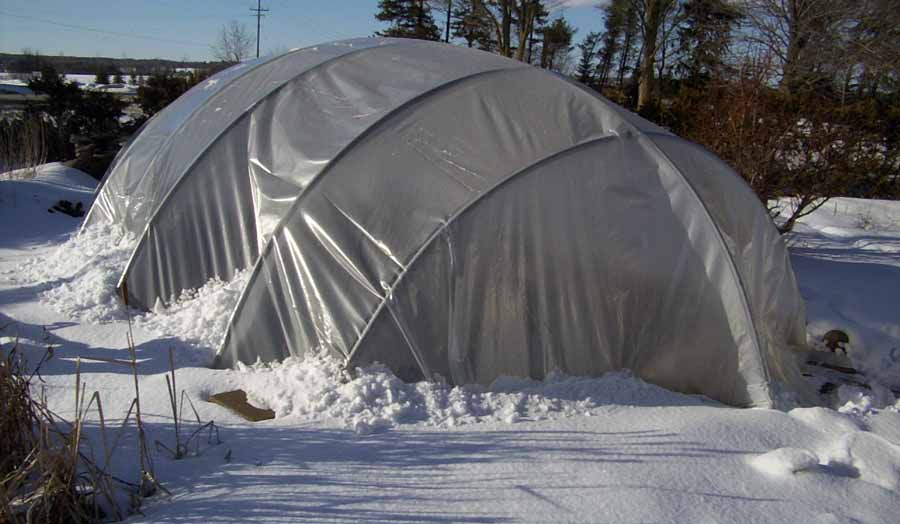
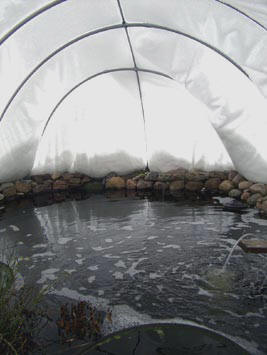
A winter pond cover provides protection from extreme winter temperatures. If you live in an area that experiences cold temperatures like we do, a winter pond cover can be a life saver, literally. We have covered our main pond during the winter for several years, and have great success. The winter pond acts like a greenhouse, warming up significantly on sunny days, and trapping the heat inside during the night. It also eliminates cold wind from sweeping across the pond, pulling heat from any open water.  

Benefits of a Winter Pond Cover:

  1. Easy to build – takes only a few hours
  2. Little or no ice forms on the pond
  3. Reusable year after year
  4. Easy to disassemble and store

The picture to the right was taken in mid January  after a very cold night. As you can see the pond was completely free from ice and remained so all winter long . We still recommend using a Pond Heater / De-Icer, Small or Large Aeration Kit.

The components of the frame can be purchased at most building supply stores
inside a winter pond cover


winter pond cover support

Supplies You Will Need:

  • 1-1/4″ PVC electrical conduit for the arches – 10′ lengths
  • 3/4″ PVC electrical conduit for the ‘spine’ at top of arches- 10′ lengths
  • 3/4″ galvanized metal electrical conduit to support arches – 10′ lengths
  • 6 mil plastic (some customers have reported success with heavy duty tarps)
  • 2 pieces of re-bar 3′ to 4′ long
  • duct tape

Planning the Arches:

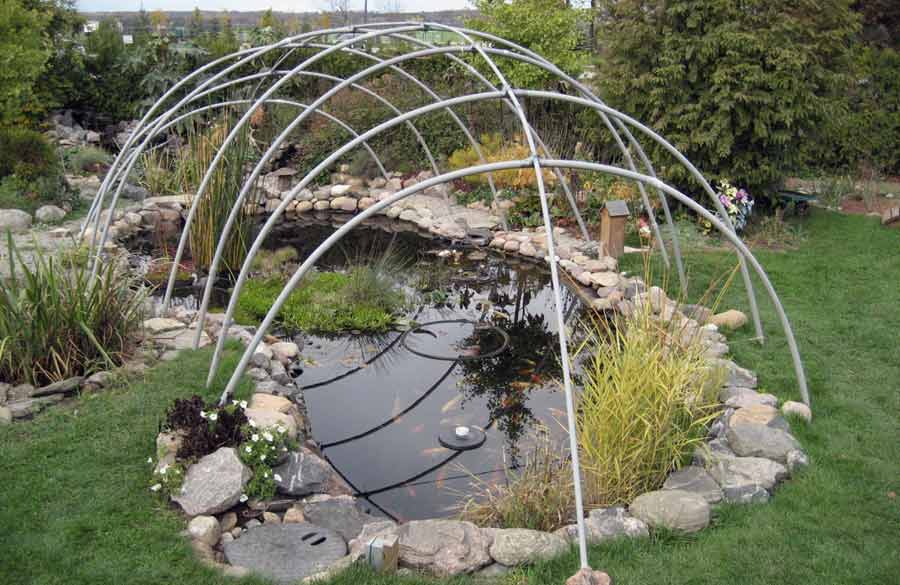
Number of Arches: You will need to calculate how many arches you need depending on length of your pond. Arches should be placed 3′ to 3-1/2′ apart.

 Arch Height: The height of the arch depends on the width of the pond. A general rule of thumb is that the arch height must be at least 60% of its width.

For example: an arch that spans a 12′ wide pond should be at least 7.2′ tall
winter pond cover base

Assembly Instructions

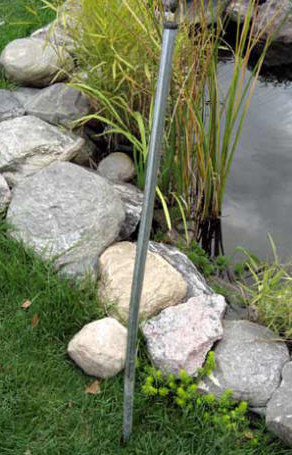
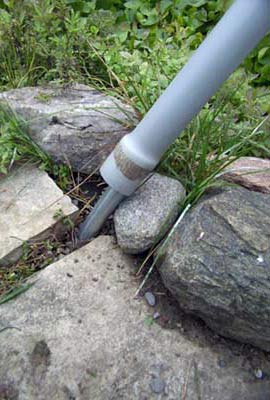
  • Cut 10′ galvanized conduit in half. Take each of the resulting 5′ stakes and drive them into the ground about 2′ -2-1/2′ deep – angled toward the pond. These will serve as supports for the 1-1/4″ diameter arches. The arches are simply slid over the stakes. (see picture above)
  • The stakes should be spaced 3′ to 3-1/2 ‘ apart or closer (depending on the snowfall in your area)
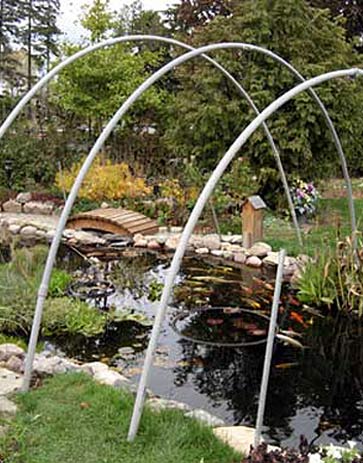
  • Begin to place your arches. Start in the middle of the pond and make this arch the tallest. More than one piece of conduit will be needed for medium and large ponds, the conduit simply slips together with male/female ends. Cut the conduit to length for proper size. Make each successive arch slightly shorter so that you will achieve a gradual arc in the ‘spine’ and an overall dome shape to the structure
winter pond cover arches

Final Touches:

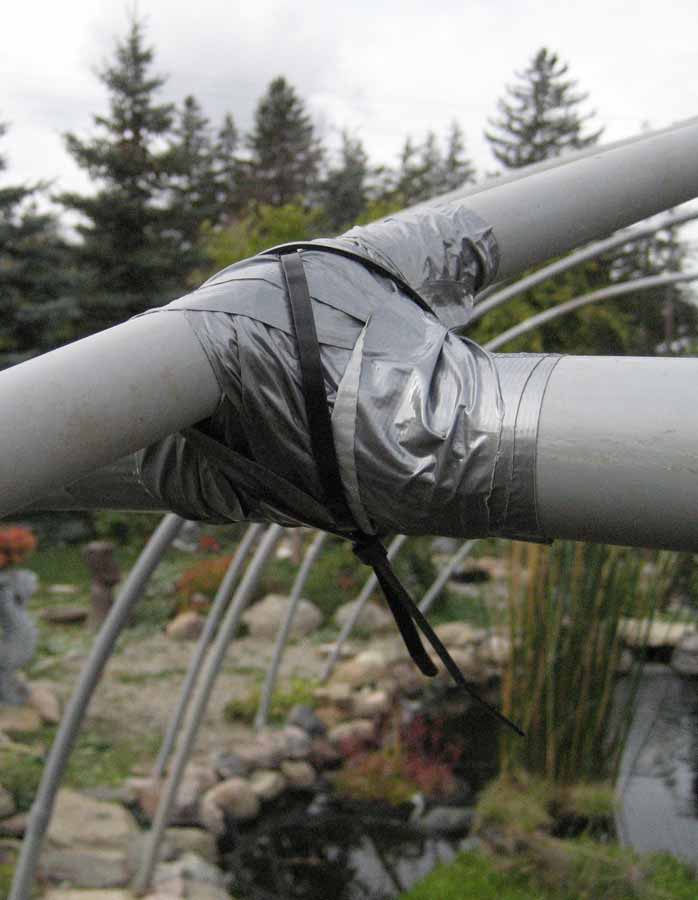
  • Once all arches are in place, affix the 3/4″ spine to the top of each arch with duct tape and cable ties. It can be tricky on larger ponds but it is essential to attach the arches to the spine securely. Drive the re-bar into the ground at each end of the pond and slip the spine over each piece to anchor it
  • Now for the plastic. Wait for a calm day and pull the plastic over the frame. Once in place, do not trim too much excess plastic from the edges, rather roll up the surplus and use this as the base to place your weights on.
    Placing lots of weight to hold the plastic in place is critical! Use whatever is available, rocks, concrete blocks, sand bags etc. Place extra weight on the side where the prevailing wind comes from.
winter pond cover joint

IMPORTANT!

If you live in an area that receives large amounts of snow, it is critical to shovel the snow from around the base of the dome. If the snow is allowed to pile up too much around the base, the excessive weight can put too much pressure causing the plastic to split or the frame to warp or bend.

Also check out Get Ready For Winter page
winter pond cover frame

Daily Pond Tip

Regular, partial water changes help to improve water quality by flushing out dissolved waste materials and replenishing essential minerals.

Daily Pond Tip

Pond Dye helps reduce algae growth in ponds by reducing the amount of sunlight that enters the pond. Submerged algae (and plants) cannot grow if they don’t receive enough sunlight.

Daily Pond Tip

All parts of the lotus plant are used in traditional medicine for treating abdominal cramps, bleeding ulcers, sunstroke, insomnia, skin ailments and many more.

Daily Pond Tip

Water Lilies come in different sizes. If you have a small pond, choose a water lily with a small spread so it doesn’t overtake your pond. If you have a large pond, you can choose lilies with small, medium or large spreads.

Daily Pond Tip

Utsuri – is the term used to describe a koi with only 2 colours. It is a black koi with one other colour such as white (Shiro Utsuri), red (Hi Utsuri), or yellow (Ki Utsuri)

Daily Pond Tip

Hanako, the oldest koi have ever lived, was born in 1751 and lived until July 7, 1977 - an extrordinary 226 years! The age of Hanako was verifed by scale analysis. July 7 was named National Koi Day in honour of Hanako.

Daily Pond Tip

Keep a close eye on your pond during the winter months to ensure there is an opening in the ice to allow oxygen into the water and gases to escape.

Daily Pond Tip

Tosai is the Japanese term that refers to a koi that is 1 year old. Learn more Japanese Koi Terminolgy.

Daily Pond Tip

Adding LED Pond Lighting is great way to extend the time you can enjoy your pond. Lighting up waterfalls or fountains adds a whole new dimension to your pond at night.

Daily Pond Tip

Lotus make stunning pond plants. The larger varieties have huge leaves that grow up to 24” in diameter held up to 3 feet above the water. Their flowers are very fragrant and measure up to 8” in diameter. There are also medium and dwarf sized lotus that will suit any size pond or water feature.

Daily Pond Tip

Yes, water lettuce do actually flower! However, the flowers are so small most people never actually notice them.

Daily Pond Tip

Chagoi are single coloured koi that range from light greenish brown to dark brown. Although they don’t have bright colours or intricate patterns, they are well known for growing larger than other varieties. They are also renowned for being very friendly and docile and are usually the first koi to come and eat food from your hand.

Daily Pond Tip

Oxy-Pond Cleaners are a great product for spot treating string algae on waterfalls and in shallow streams. Simply turn off your pump, sprinkle it on any algae, wait about 15 minutes and turn your pump back on.

Daily Pond Tip

Great Blue Herons are typically solitary birds, so placing a lifelike heron decoy at eh edge of your pond often deters them from visiting your pond and eating your fish. If you have a heron that lives near your pond, moving your decoy around from time helps to maintain illusion.

Daily Pond Tip

Goldfish make ideal pets for small ponds because of their modest size. They typically grow 8”- 10" long, although they can occasionally get bigger. The best types of goldfish for outdoor ponds are Comets, Sarasa Goldfish and Shubunkins.

Daily Pond Tip

Having some algae in your pond isn’t a bad thing. In fact, algae consumes nutrients and waste products and helps to purify your pond water. Many small zooplankton feed on algae which then become food for small fish.