905-715-2447 September Hours: Wednesday to Saturday 10:00 am - 5:00 pm 3301 Sideroad 10, Bradford, ON Canada

How To Build a Winter Pond Cover

Hydrosphere Water Gardens > Pond Advice & Tips > How To Build a Winter Pond Cover

How To Build a Winter Pond Cover

Winter Pond cover

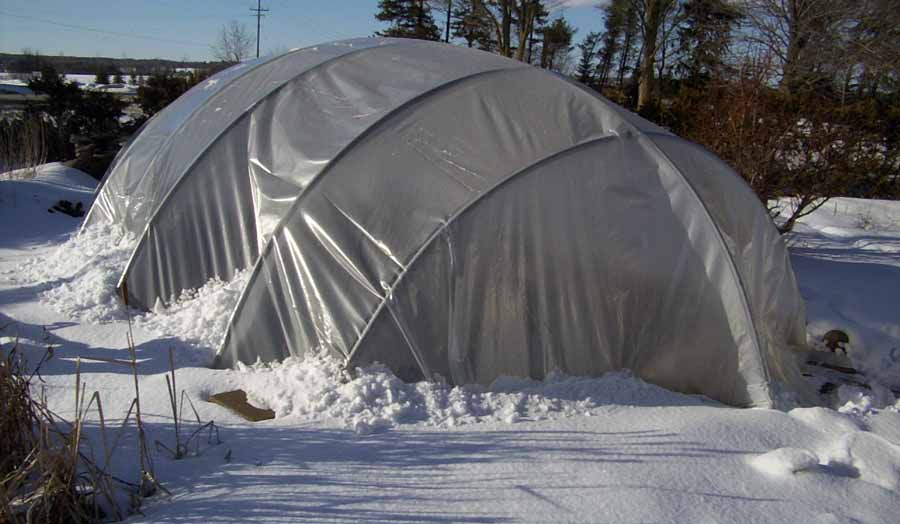
A winter pond cover provides protection from extreme winter temperatures. If you live in an area that experiences cold temperatures like we do, a winter pond cover can be a life saver, literally. We have covered our main pond during the winter for several years, and have great success. The winter pond acts like a greenhouse, warming up significantly on sunny days, and trapping the heat inside during the night. It also eliminates cold wind from sweeping across the pond, pulling heat from any open water.  

Benefits of a Winter Pond Cover:

  1. Easy to build – takes only a few hours
  2. Little or no ice forms on the pond
  3. Reusable year after year
  4. Easy to disassemble and store

The picture to the right was taken in mid January  after a very cold night. As you can see the pond was completely free from ice and remained so all winter long . We still recommend using a Pond Heater / De-Icer, Small or Large Aeration Kit.

The components of the frame can be purchased at most building supply stores
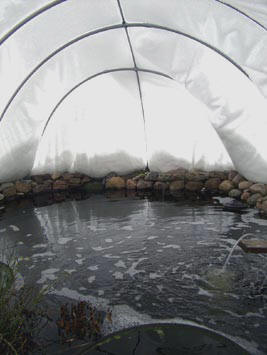
inside a winter pond cover


winter pond cover support

Supplies You Will Need:

  • 1-1/4″ PVC electrical conduit for the arches – 10′ lengths
  • 3/4″ PVC electrical conduit for the ‘spine’ at top of arches- 10′ lengths
  • 3/4″ galvanized metal electrical conduit to support arches – 10′ lengths
  • 6 mil plastic (some customers have reported success with heavy duty tarps)
  • 2 pieces of re-bar 3′ to 4′ long
  • duct tape

Planning the Arches:

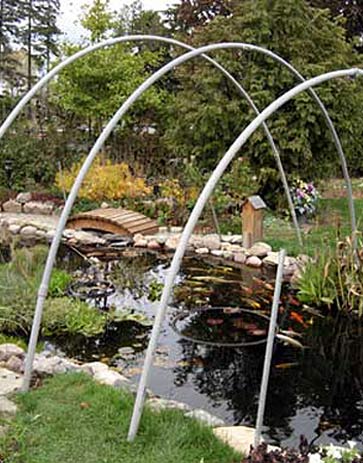
Number of Arches: You will need to calculate how many arches you need depending on length of your pond. Arches should be placed 3′ to 3-1/2′ apart.

 Arch Height: The height of the arch depends on the width of the pond. A general rule of thumb is that the arch height must be at least 60% of its width.

For example: an arch that spans a 12′ wide pond should be at least 7.2′ tall
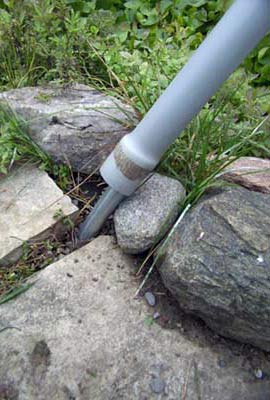
winter pond cover base

Assembly Instructions

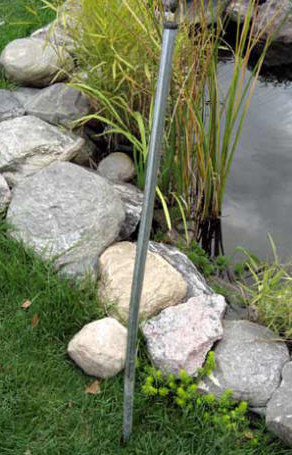
  • Cut 10′ galvanized conduit in half. Take each of the resulting 5′ stakes and drive them into the ground about 2′ -2-1/2′ deep – angled toward the pond. These will serve as supports for the 1-1/4″ diameter arches. The arches are simply slid over the stakes. (see picture above)
  • The stakes should be spaced 3′ to 3-1/2 ‘ apart or closer (depending on the snowfall in your area)
  • Begin to place your arches. Start in the middle of the pond and make this arch the tallest. More than one piece of conduit will be needed for medium and large ponds, the conduit simply slips together with male/female ends. Cut the conduit to length for proper size. Make each successive arch slightly shorter so that you will achieve a gradual arc in the ‘spine’ and an overall dome shape to the structure
winter pond cover arches

Final Touches:

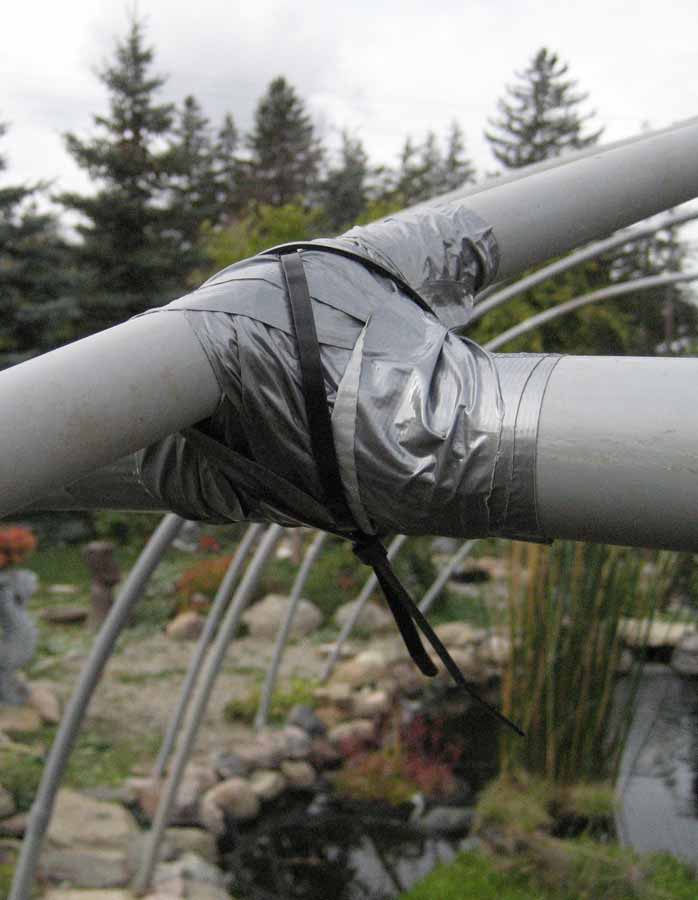
  • Once all arches are in place, affix the 3/4″ spine to the top of each arch with duct tape and cable ties. It can be tricky on larger ponds but it is essential to attach the arches to the spine securely. Drive the re-bar into the ground at each end of the pond and slip the spine over each piece to anchor it
  • Now for the plastic. Wait for a calm day and pull the plastic over the frame. Once in place, do not trim too much excess plastic from the edges, rather roll up the surplus and use this as the base to place your weights on.
    Placing lots of weight to hold the plastic in place is critical! Use whatever is available, rocks, concrete blocks, sand bags etc. Place extra weight on the side where the prevailing wind comes from.
winter pond cover joint

IMPORTANT!

If you live in an area that receives large amounts of snow, it is critical to shovel the snow from around the base of the dome. If the snow is allowed to pile up too much around the base, the excessive weight can put too much pressure causing the plastic to split or the frame to warp or bend.

Also check out Get Ready For Winter page
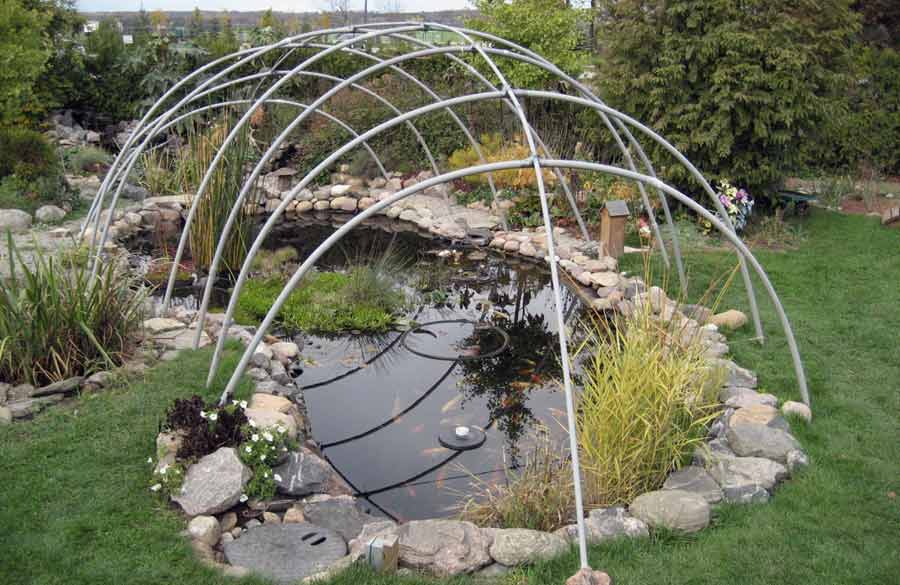
winter pond cover frame

Daily Pond Tip

Montmorillonite clay powder that is used widely throughout the world in koi ponds and water gardens. It adds and replenishes the minerals and trace elements that are found in natural ponds, but missing in rubber lined ponds. It contains over 60 bio-available minerals and trace elements, including calcium, magnesium, potassium, sodium, and iron.

Daily Pond Tip

Maintaining proper pH level in your pond is important. Ideally your pond water should measure between 7.0 and 8.0. As long as it falls within these values, there is no need to adjust it up or down.

Daily Pond Tip

Costia is common microscopic parasite that is active in cool water. They are smaller than most parasites and are shaped like a comma when viewed under a microscope.

Daily Pond Tip

Performing regular, parial water changes is a great way to maintain optimal water quality. Changing 10%-15% of the pond water every week or 2, helps to flush out nitrates, tannins and other waste products while replenishing essential minerals.

Daily Pond Tip

Koi make wonderful pets for larger ponds. Because they can often grow up to 24” / 60 cm long (or even larger), they are not well suited to small ponds. Ideally, your pond should be a minimum of 48” / 122 cm deep to adequately house koi.

Daily Pond Tip

Pond Flocculants help to clear cloudy water by clumping small particles together so they can be trapped by your filter.

Daily Pond Tip

Frog and toad tadpoles are wonderful additions to ponds. Not only is it fun to watch them develop from tadpole to frog or toad, but they also consume copious amounts of algae