
905-715-2447 November Hours: Thursday to Saturday 10:00 am - 5:00 pm 3301 Sideroad 10, Bradford, ON Canada

Ammonia In Ponds and Aquariums

Hydrosphere Water Gardens > Pond Advice & Tips > Ammonia In Ponds and Aquariums

Ammonia In Ponds and Aquariums

and How to Lower It

Ammonia in ponds and aquariums is a common problem. Ammonia stress and poisoning is often the number one cause of fish illness and deaths when setting up new aquariums, small ponds and quarantine tanks.  This is often referred to as ‘New Tank Syndrome’. It is not usually as common a problem in new larger ponds because the ammonia is diluted in the larger volume of water and doesn’t reach toxic levels. Ammonia stress can also occur in well established ponds for a variety of different reasons. It can also be the cause of a parasite or bacterial outbreak because it stresses and weakens the fish, making them more vulnerable to pathogens in the water.

Luckily, koi and goldfish as well as many aquarium fish are quite resilient and can withstand low ammonia levels for a few days without any adverse effects. But ammonia levels can rise to dangerous levels quite quickly and lead to serious fish health problems and deaths.

What is Ammonia and Where Does it Come From?

Ammonia is the primary waste product of fish. It is excreted mainly through their gills and to a lesser extent as urine. It can also come from decaying plant matter, dead algae or dead fish or other animals in the pond.

 What are the Symptoms of Ammonia Stress?

The first signs of ammonia stress in fish is a change in their behaviour. In ponds or aquariums with high ammonia levels, fish will often become less active and hang at the surface of the water gasping, often near waterfalls or filter returns.

Other signs include:

  • sitting on the bottom
  • loss of appetite
  • fins clamped close to their body
  • excess mucous slime coat

A closer inspection of the fish usually shows reddening of the skin and damage to their gills.

How Does Ammonia Affect Fish?

Even low levels of ammonia, below 0.25 ppm (parts per million), can suppress the fish’s immune system and make the fish more susceptible to bacterial and parasitic infections.

High levels of ammonia, 1.0 ppm or more, have a caustic effect on a fish’s gills with sudden and dramatics effects. Higher levels of ammonia will ‘burn’ the gills and actually cause swelling and even serious damage to the structure of the gills. Fish not only use their gills to breath, but also for waste excretion an osmoregulation (the balance of water and salts in the body). This drastically reduces the ability of the gills to function properly and also makes them more susceptible to infection. It only takes a few days of high ammonia levels to seriously harm fish.

What Causes Ammonia?

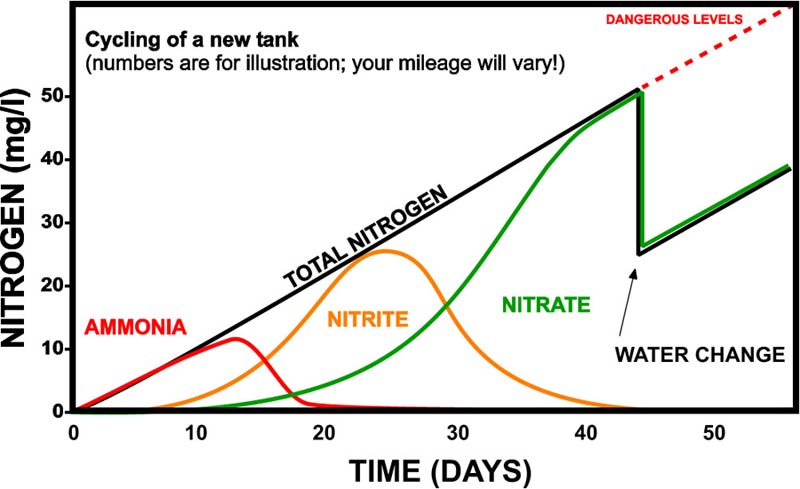
Ammonia is present in all ponds and aquariums, but usually at very low levels. That is because in an established pond with a properly functioning filter, toxic ammonia is quickly converted into relatively harmless nitrates by beneficial bacteria through a series of biological steps. This process of converting ammonia into nitrates is called The Nitrogen Cycle, also known as ‘The Cycle’ or ‘Cycling a Tank’.
The Nitrogen Cycle

The Nitrogen Cycle - Ammonia in Ponds and Aquariums

Here’s how the Nitrogen Cycle starts when you set up a new pond or aquarium.

  1. Once you add some fish and begin feeding them, the fish immediately start producing ammonia waste and it starts to gradually build up in the water.
  2. As the Ammonia level increases (follow the RED line in the graph above) beneficial bacteria called Nitrosomonas begin to use the ammonia as a food source and convert it into Nitrites. As these bacteria multiply, they are able to consume more and more ammonia so that eventually ammonia levels will drop to almost zero.
  3. Nitrites (the ORANGE line) are less toxic to fish than ammonia, but are still very dangerous at higher levels and can kill fish. As the Nitrite levels increase, a different bacteria called Nitrobacter begin to convert the Nitrite into less harmful Nitrates (the GREEN line). As the Nitrobacter bacteria multiply, Nitrites will be also be converted more quickly into nitrates so that the Nitrite level in the water will be virtually zero.
  4. Nitrates will accumulate in a pond or aquarium that has no plants or algae. Nitrates are not broken down by bacteria like ammonia and nitrites. Although Nitrate does not directly affect fish like ammonia or nitrite, chronic high levels (over 50 ppm) can start to weaken fishes immune systems, making them more vulnerable to infections and parasites. To reduce Nitrates and maintain healthy levels in an aquarium, weekly partial water changes (10% to 20%) should be performed. In a pond, nature has a way of taking care of nitrates – ALGAE! Algae and plants feed on nitrates, so if you don’t want pea soup green water or string algae overtaking your pond, add plants to consume the nitrates. Check out our Clear Water Plants page for more tips.


The process above is completely natural, if you are patient when you first start up a pond or aquarium and don’t add too many fish during the first month or two, you shouldn’t have any major water quality problems or sick fish. Problems usually occur when enthusiastic hobbyists add too many fish too fast to a new aquarium and don’t check their water quality.

In established systems, ammonia levels can also become dangerously high for a variety of reasons. Inadequate filtration or circulation, overfeeding, overstocking, spawning, and  extended power outages can cause ammonia spikes. Another fairly common way to cause an ammonia spike is killing a lot of algae and not removing it from the pond. The decaying algae can consume oxygen and raise ammonia levels.

How to Prevent High Ammonia Levels

  • Check water quality regularly
  • Have adequate (or more than adequate) filtration and circulation
  • Don’t overstock your system with fish
  • Don’t overfeed your fish
  • Be patient when starting a new system

What Is Considered a Safe Level of Ammonia?

Other than in a new system, Ammonia levels should always be zero, or very close to zero. The presence of any ammonia in an established pond or aquarium should be a sign that something is amiss and should be investigated. Ammonia levels above 0.25 ppm should be a concern, anything above 1.0 ppm should be acted upon immediately.

What To Do If I Have High Ammonia Levels?

If you have high ammonia levels, above 1.0 ppm, the first thing to do is a partial water change. How much of a water change and how often to change water depends on the levels. 20% to 30% water changes daily should be adequate to help lower the ammonia levels. In this situation, check your water quality daily, or even twice a day with a Test Kit. If the ammonia levels are above 5.0 ppm, you could increase the amount of water that you change, but extra care must be taken not to shock the fish. Any time you perform a water change, always use a Dechlorinator to remove chlorine and chloramines if you are on town water, always try to make sure the water you are adding to the pond is the same temperature as the pond water (especially if you are doing a large water change).

Add Beneficial Bacteria to your pond or aquarium. There are several good products like Microbe Lift PL that help to establish or restore the beneficial bacteria in your system. In ponds, it is always a good idea to get a head start in the spring by adding Cold Water Beneficial Bacteria that are designed to perform in cold water temperatures.

Ammonia Remover additives are also effective at binding up toxic ammonia so that they don’t harm the fish. The resulting ‘bound’ ammonia is then removed naturally by the beneficial bacteria.

Daily Pond Tip

Regular, partial water changes help to improve water quality by flushing out dissolved waste materials and replenishing essential minerals.

Daily Pond Tip

One of the most significant advantages of using  Kaldnes or similar filter media in a moving bed filter is its self-cleaning property. As the media moves within the filter, it continuously rubs against other media pieces. This abrasion helps to slough off excess biofilm, preventing the media from becoming clogged and maintaining optimal filtration efficiency.

Daily Pond Tip

Water lily flowers close at night to protect their delicate structures from predators or getting too damp from heavy morning dew

Daily Pond Tip

Pond Dye helps reduce algae growth in ponds by reducing the amount of sunlight that enters the pond. Submerged algae (and plants) cannot grow if they don’t receive enough sunlight.

Daily Pond Tip

All parts of the lotus plant are used in traditional medicine for treating abdominal cramps, bleeding ulcers, sunstroke, insomnia, skin ailments and many more.

Daily Pond Tip

Water Lilies come in different sizes. If you have a small pond, choose a water lily with a small spread so it doesn’t overtake your pond. If you have a large pond, you can choose lilies with small, medium or large spreads.

Daily Pond Tip

Utsuri – is the term used to describe a koi with only 2 colours. It is a black koi with one other colour such as white (Shiro Utsuri), red (Hi Utsuri), or yellow (Ki Utsuri)

Daily Pond Tip

Hanako, the oldest koi have ever lived, was born in 1751 and lived until July 7, 1977 - an extrordinary 226 years! The age of Hanako was verifed by scale analysis. July 7 was named National Koi Day in honour of Hanako.

Daily Pond Tip

Keep a close eye on your pond during the winter months to ensure there is an opening in the ice to allow oxygen into the water and gases to escape.

Daily Pond Tip

Tosai is the Japanese term that refers to a koi that is 1 year old. Learn more Japanese Koi Terminolgy.

Daily Pond Tip

Adding LED Pond Lighting is great way to extend the time you can enjoy your pond. Lighting up waterfalls or fountains adds a whole new dimension to your pond at night.

Daily Pond Tip

Lotus make stunning pond plants. The larger varieties have huge leaves that grow up to 24” in diameter held up to 3 feet above the water. Their flowers are very fragrant and measure up to 8” in diameter. There are also medium and dwarf sized lotus that will suit any size pond or water feature.

Daily Pond Tip

Yes, water lettuce do actually flower! However, the flowers are so small most people never actually notice them.

Daily Pond Tip

Chagoi are single coloured koi that range from light greenish brown to dark brown. Although they don’t have bright colours or intricate patterns, they are well known for growing larger than other varieties. They are also renowned for being very friendly and docile and are usually the first koi to come and eat food from your hand.

Daily Pond Tip

Oxy-Pond Cleaners are a great product for spot treating string algae on waterfalls and in shallow streams. Simply turn off your pump, sprinkle it on any algae, wait about 15 minutes and turn your pump back on.

Daily Pond Tip

Great Blue Herons are typically solitary birds, so placing a lifelike heron decoy at eh edge of your pond often deters them from visiting your pond and eating your fish. If you have a heron that lives near your pond, moving your decoy around from time helps to maintain illusion.