
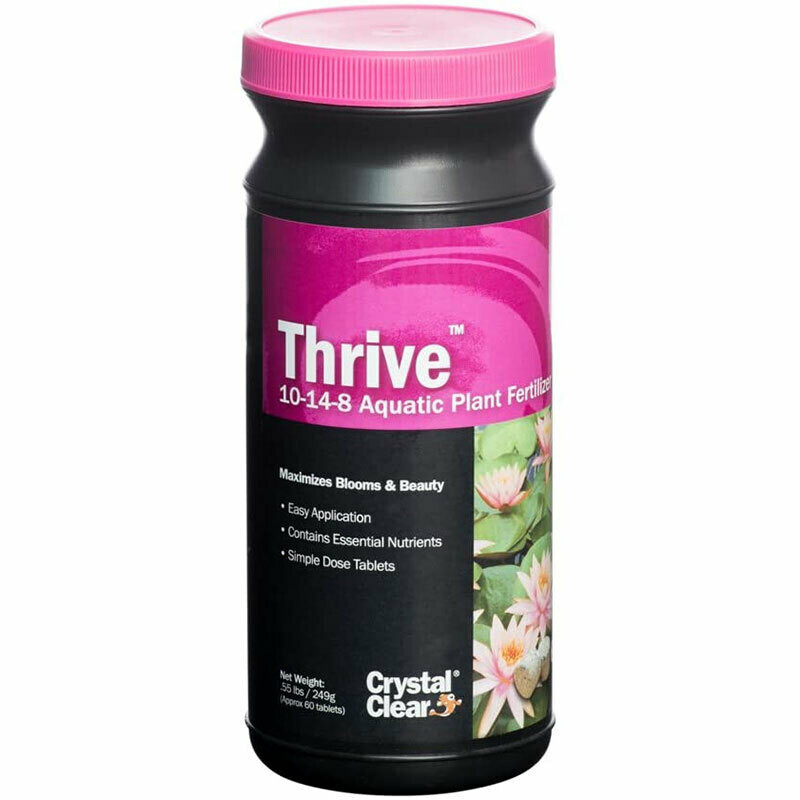
Thrive Aquatic Plant Fertilizer - 60 Tablets
CrystalClear® Thrive Aquatic Plant Fertilizer 10-14-8 formulation is ideal for keeping flowering as well as non-flowering aquatic plants vibrant and colourful. CrystalClear® Aquatic Plant Fertilizer will efficiently feed aquatic plants without releasing any harmful chemicals into the water that might contribute to algal growth.
Features:
When To Apply Thrive™
CrystalClear® Aquatic Plant Fertilizer offers a simple application that makes plant care easy and mess free. Simply use one tablet for every gallon of soil each month during the growing season.
How To Apply Thrive™
Push one tablet one finger deep into the soil, 3" from the crown of the plant. Then press the soil around the inserted tablet to prevent fertilizer from being released into the water. Once this is complete aquatic plants should not need fed again for another month. It is always a good idea to feed plants every two weeks when the water temperature raises above 75 degrees Fahrenheit.
|
CrystalClear® Aquatic Plant Fertilizer Guaranteed Analysis |
|||
|
10-14-8 |
|||
|
|
|||
|
Total Nitrogen (N) |
10.0% |
Boron (B) |
0.02% |
|
5.5% |
Ammonical Nitrogen |
Soluble Copper (Cu) |
0.05% |
|
2.4% |
Nitrate Nitrogen |
Soluble Iron (Fe) |
0.11% |
|
1.5% |
Water Insoluble Nitrogen |
Soluble Manganese |
0.12% |
|
0.6% |
Urea Nitrogen |
Molybdenum (Mo) |
0.0006% |
|
Available Phosphate (P2O5) |
14% |
Soluble Zinc (Zn) |
0.07% |
|
Soluble Potash (K2O) |
8.0% |
|
|