
Choosing the best pond vacuum may seem a bit difficult because there are many options. However we have done a bit of the homework for you by comparing the options from Oase, the best brand of pond vacuums.
In recent years, pond vacuums have become more and more popular. Advancements in their design and technology in has made them easier to use and more effective for cleaning ponds.
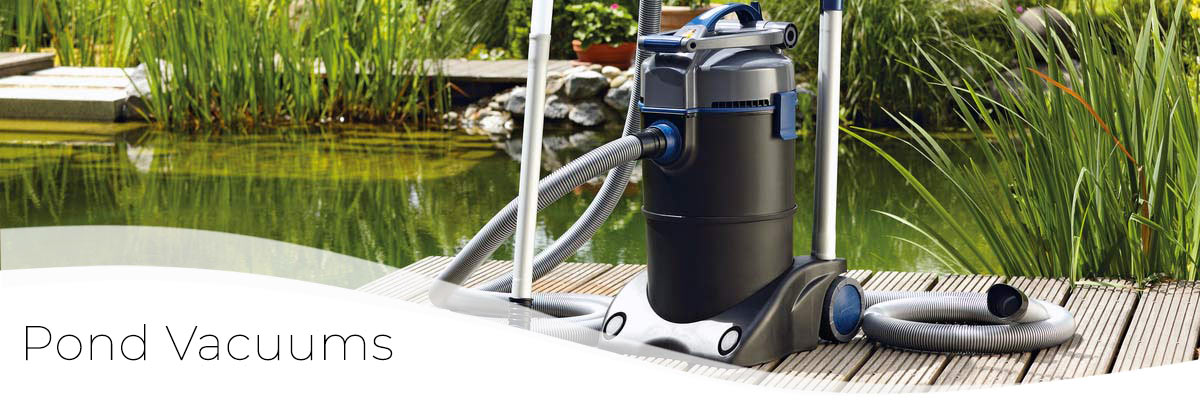
Pond vacuums are used to remove debris that settles on the bottom of ponds. If you have fish in your pond, it is essential to regularly remove the debris that settles on the bottom to reduce algae growth and maintain good water quality and clarity.
You can easily remove large debris like leaves and twigs, thick and heavy debris like soil, muck and sludge, as well as fine waste like sand and silt without clouding the pond very much. This allows you to work constantly until the pond is clean.
On the other hand, when you try to remove this type of debris from your pond with a net, much of the debris escapes from the net, or is pulled to the surface as you remove the net, causing the water to become cloudy very quickly. In most cases, after taking a few scoops from the pond, you need to wait for a while to let the debris settle so the water is clear enough to see what you a doing.
Although the specifics vary depending on the model you use, most pond vacuums work by suck debris and water from the bottom of the pond and discharge it outside of the pond on the lawn, flowerbed, or even into the sewer. Most pond vacuums do not filter the water they collect. In most cases, when you are vacuuming your pond, the dirt and sludge that is collected is too dirty to be filtered and returned to the pond. One exception to this is if your pond is already fairly clean, and you are just vacuuming tree leaves that have fallen into your pond in the autumn. In this case, you can use place a collection bag over the end of the discharge hose to collect the leaves, and let the clean water return to the pond.
Years ago, the only way to vacuum your pond was with a ‘shop vac’ vacuum, typically designed for household wet/dry use. Although shop vacs are powerful, they tend to fill very quickly, and need to be manually emptied every time which involves moving it to the spot where you want to dump it, removing the lid, tipping it over to drain it, and hope you don’t dump it on your shoes. On an average size pond, you would likely need to repeat this about 20 times. Needless to say, this is a lot of heavy, tedious work, and not a good option for cleaning your pond.
Generally, when you vacuum your pond, you don’t remove too much water. In a relatively well maintained pond, you probably only would need to drain about 6″ (15 cm) when vacuuming, which is a relatively small water change. In fact, partial water changes are always beneficial because they help to remove nitrates, tannins and other compounds that accumulate in your pond, and also help replenish beneficial buffers.
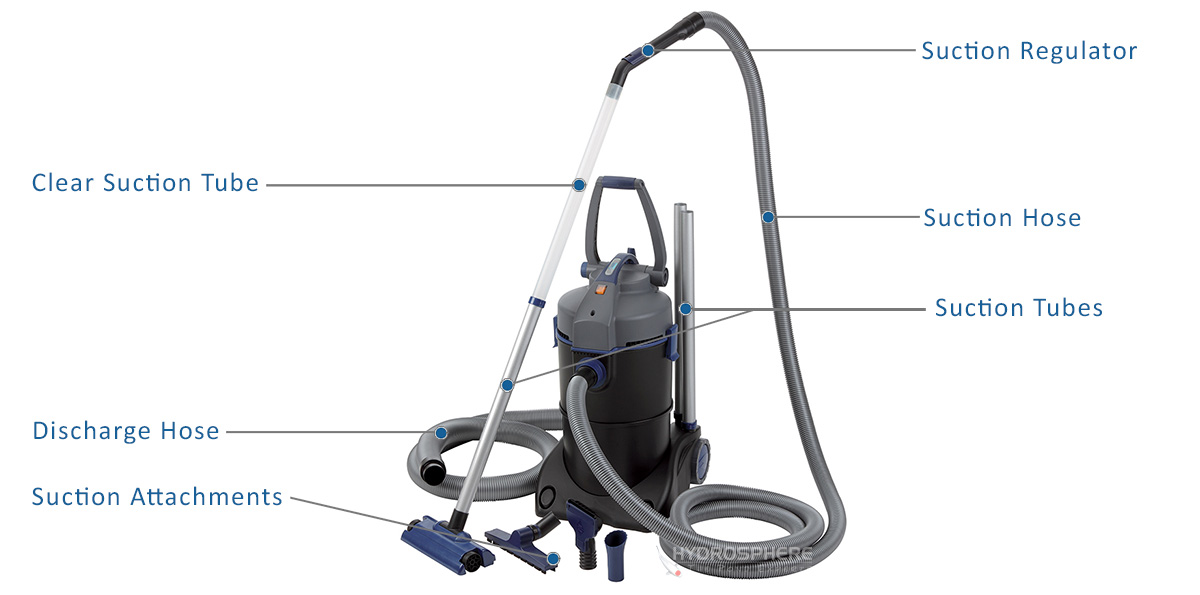
Basically, most pond vacuums have the same initial setup. Simply attach one end of the discharge hose to the drain opening of the vacuum, and position the other end away from the pond on the lawn, flowerbed etc. You can place the collection bag over the end of the drain line to catch large debris. The waste from the pond makes excellent fertilizer for the lawn, flowerbed or garden!
Next, attach the suction hose to the vacuum and attach one or more suction tubes to the suction hose handle. If you are vacuuming a stream or shallow section of your pond, you might only need to attach 1 suction tube. In deeper areas of the pond, you might use 3 or 4 suction tubes. Oase pond vacuums also come with a handy clear suction tube which allow you to see how dirty the water is in the area you are vacuuming. Depending on your pond, you may want to use one of the various suction attachments such as crevice nozzle, algae nozzle, gravel nozzle etc. which are easily attached to the extension tube.
Plug in your vacuum and start vacuuming!
Is based on the original design of Oase pond vacuums, but has been improved over the years. It has one chamber that collects the sludge and debris from the pond. Once this chamber is full, the vacuum automatically turns off to allow the chamber to drain. After 25 seconds, the chamber is drained and the vacuum automatically turns back on so you can begin vacuuming again. There is no need to manually empty the vacuum, and the whole process works very well. This cycle repeats itself until you are finished vacuuming.
PondoVac Classics are not only are useful at pond cleaning but they can also be used as wet or shop vacuum around the house.
Features:
It is important to place the PondoVac Classic on level ground to allow it to drain properly.
Oase PondoVac 3 is markedly improved over the PondoVac Classic, because it vacuums much faster than the Classic.
The biggest upgrade with the PondoVac 3 is that it has a dual chamber design that allows for non-stop vacuuming. As you start vacuuming, water fills the first chamber until it is full. Then the incoming dirty water is diverted to the second chamber, and the first chamber starts to drain. Once the second chamber is full, the incoming water is diverted back to the first chamber. With this dual chamber system, the vacuum does not turn off while waiting for the vacuum to drain. As one chamber fills, the other drains in a continuous cycle, cutting the vacuuming time in half.
PondoVac 3 Features:
It is important to place the PondoVac 3 on level ground to allow it to drain properly.
Oase PondoVac 3 and 4 models are both very similar to each other except the PondoVac 4 is more powerful and can clean deeper ponds. However, they are markedly improved over the PondoVac Classic, as they both work much faster.
The biggest upgrade with the PondoVac 3 / 4 over the classic is that they have a dual chamber design that allows for non-stop vacuuming. As you start vacuuming, water fills the first chamber until it is full. Then the incoming dirty water is diverted to the second chamber, and the first chamber starts to drain. Once the second chamber is full, the incoming water is diverted back to the first chamber. With this dual chamber system, the vacuum does not turn off while waiting for the vacuum to drain. As one chamber fills, the other drains in a continuous cycle, cutting the vacuuming time in half.
PondoVac 4 Features:
It is important to place the PondoVac 3/4 on level ground to allow it to drain properly.
The PondoVac 5 has another big improvement over the previous models. This vacuum has a single chamber, dual pump design that allows for non-stop cleaning and improved dirty water discharge.
The PondoVac 5 has a dedicated discharge pump that pumps the dirty water from the vacuum, rather than relying on gravity to drain it. This allows you to pump the dirty water up hills and a lot farther than PondoVac Classic, 3 and 4 models. The PondoVac 5 comes with a 32’ long discharge hose allowing for more options for discharge.
PondoVac 5 Features:
The PondoVac 5 can be placed anywhere near the pond. With the dedicated discharge pump, it does not need level ground to drain properly.
All of the Oase PondoVac vacuums we have listed above work great and will make cleaning your pond much easier. I’m sure you will be happy with whatever model you choose. But which vacuum is right for you?
Best Pond Vacuum For Small Ponds:
Best Value Pond Vacuum:
Best Pond Vacuum Available: