
How many fish can I have in my pond? This is a very common question. Few people realize when they first get started in the hobby, how much enjoyment they will get from keeping fish in their pond. For many people, they start out by adding a few inexpensive goldfish to their pond to add a little colour, or just to eat mosquito larvae. After a while, they begin to appreciate different varieties of goldfish, and add few more and start to get a true appreciation for fish. Soon, they start adding small koi to their pond, and once this happens the ‘fish addiction’ has taken hold. There are so many beautiful varieties of goldfish and koi, that it is often hard to resist adding just one or two more fish to your pond when you visit your local pond store.
Unfortunately there is a limit to how many fish you can safely keep in a pond. An overstocked pond is like a ticking time bomb waiting to go off if it isn’t monitored closely. Having too many fish in your pond can cause all kinds of problems, such as excessive algae growth, cloudy water or clogged filters. But these are really just inconveniences for you, the pond owner.
The serious problems that can occur when you overstock your pond is poor water quality and low oxygen levels. These create an unhealthy environment for your koi or goldfish, which ultimately leads to sick and dying fish.
So how do you know how many fish you can have in your pond?
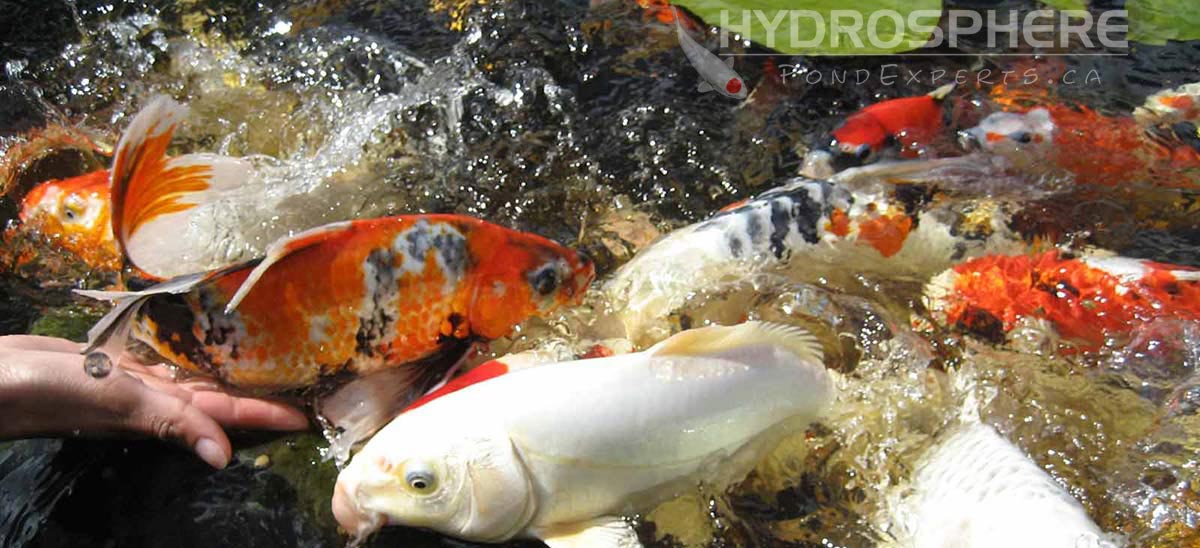
Having too many fish in your pond is a common problem for pond owners, and it is usually unintentional. Often, it happens very gradually, and you don’t even realize your pond is overstocked until there is a serious problem such as sick or dying fish.
Generally, overstocking can happen 2 different ways:
Too many fish, plain and simple. This problem is common in ponds with goldfish. Most people don’t realize how prolific goldfish are. Goldfish breed, breed and breed some more! They can spawn several times during the summer. One female goldfish can lay hundred of eggs each time she spawns. So even if you start out with only a few goldfish, within a few years, you could easily have more than 100 goldfish living in a small pond.
Having too many fish isn’t always the problem, it can be the size of the fish. Koi, for example can grow huge! When you see a 3″ or 4″ koi at the store, it’s hard to imagine that it could grow to 18″-24″ long within a few years. Many people underestimate how big and fast koi can grow.
If you were to add a dozen small koi to a 1000 gallon pond, everything would probably be fine initially. They would have plenty of room to swim, they wouldn’t produce much waste when this size and the water quality would fine. But not for too long. small koi can easily double or triple in size over the summer. Within a few years most of these 12 koi would reach 18″-24″ in length and would be very cramped in 100 gallons of water. Plus, they would produce copious amounts of waste that would cause algae blooms and water quality issues.
If you are like many pond enthusiasts, (including me), when you see that perfect fish that you have been looking for, it is hard to pass up, even though you know your pond is ‘full’. It’s easy to justify adding one more fish to your pond. You tell yourself ‘everything is fine with my pond’, or ‘my fish are thriving’, or ‘I might not see another fish like this ever again’. This usually happens more than once, and before you know it your pond is overstocked.
Having too many fish in your pond will lead definitely to problems. Initially, the issues aren’t too serious, but as your fish grow or multiply, the results can be deadly.
Overstocking a pond leads to some or all of the following issues:
Poor Water Clarity – the first thing you might notice as the number or size of your fish increases is the water clarity becomes poor. You might find the water just murky, or you might see an abundance of particles floating in the water.
Algae Growth – As the fish mass increases, so does the amount of waste they produce. As the waste levels in the water increases, algae usually is the first thing to respond by growing rampantly.
Although there is a simple formula that works fairly well for fish stocking levels in ponds, in reality, there are many variables to take into consideration. Pond design, depth, volume, filtration, circulation, aeration, feeding rate etc. all play a factor in how many fish can safely live in your pond.
One popular rule of thumb for fish stocking levels in ponds is this:
So if you have a 1000 gallon pond, this formula implies that you can have 100″ of fish in your pond. This works out to 50 – 2″ fish, 25 – 4″ fish, 10 – 10″ fish, or any combination of fish sizes that add up to 100″.
This formula actually works okay in most cases. However, you will see that this rule has its drawbacks and breaks down a bit when applying it to large koi.
The length of a koi isn’t a true measure of the size of a koi. If you really want to compare the size of fish, you need to look at their weight. In reality, you should take into account how many pounds of fish you can have, not how many inches of fish you can have in you pond.
Lets compare a fish size based on length. In particular let’s compare how many small fish are equivalent in length to 1 larger fish.
For Example :
This is pretty straight forward. If you line up all 8 of your 3″ koi in a row they measure 24″ in total., and one 24″ koi measures 24″ in length. However, length is not really the best way to compare the true ‘size’ of a fish.
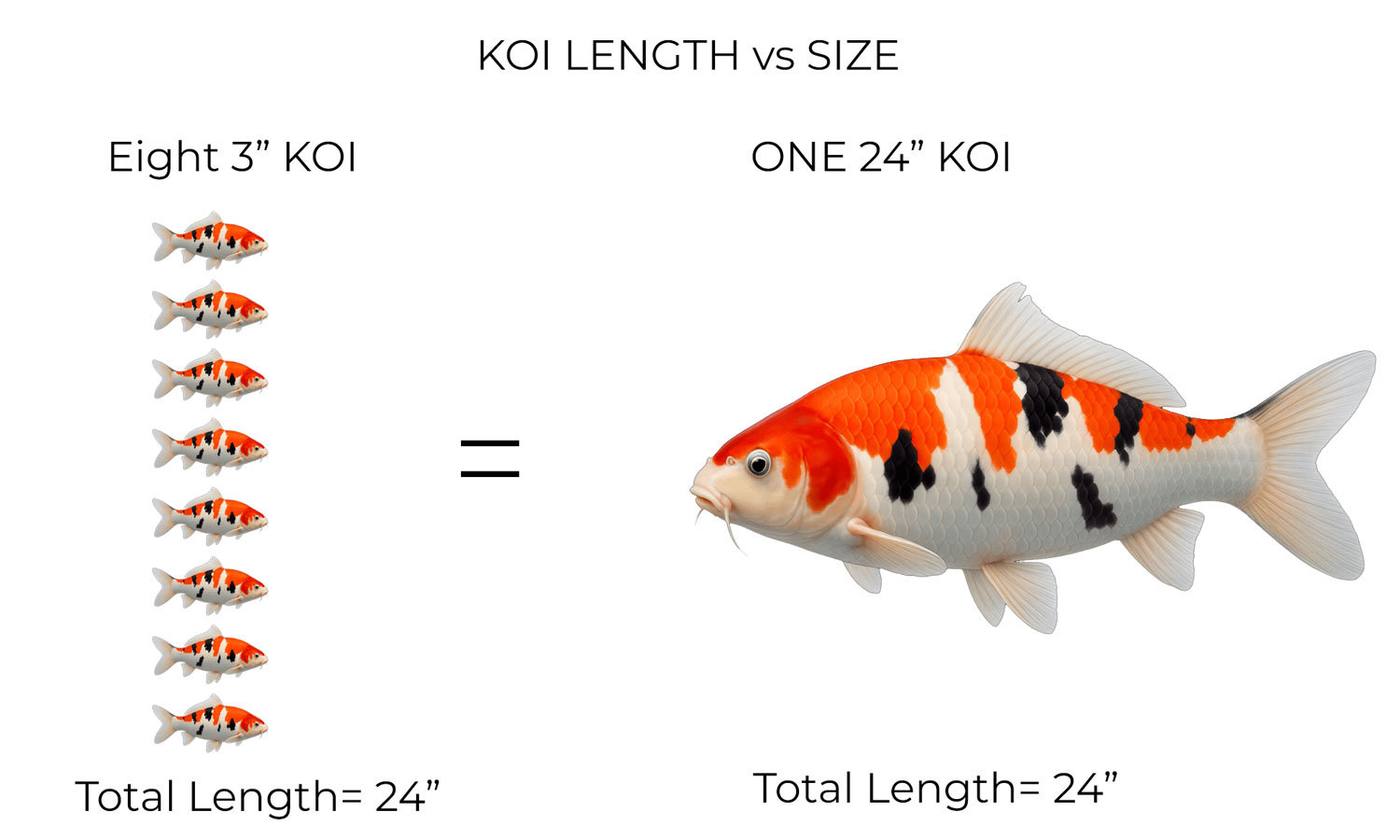
When you compare the weight of koi based on length, an interesting thing happens. The weight of a koi actually grows exponentially as its length increases.
At first glance you might think that the total weight of the (8) 3″ koi is roughly equivalent to the 24″ koi. If you double or triple the actual weight of the (8) 3″ koi, do you think this number would be equal to the weight of the 24″ koi? What if we multiply it by 10? Actually, you would have to increase it by a much larger factor.
This is a huge difference. Although the 24″ koi is only 8 times longer than a 3″ koi, it weighs 513 times more.
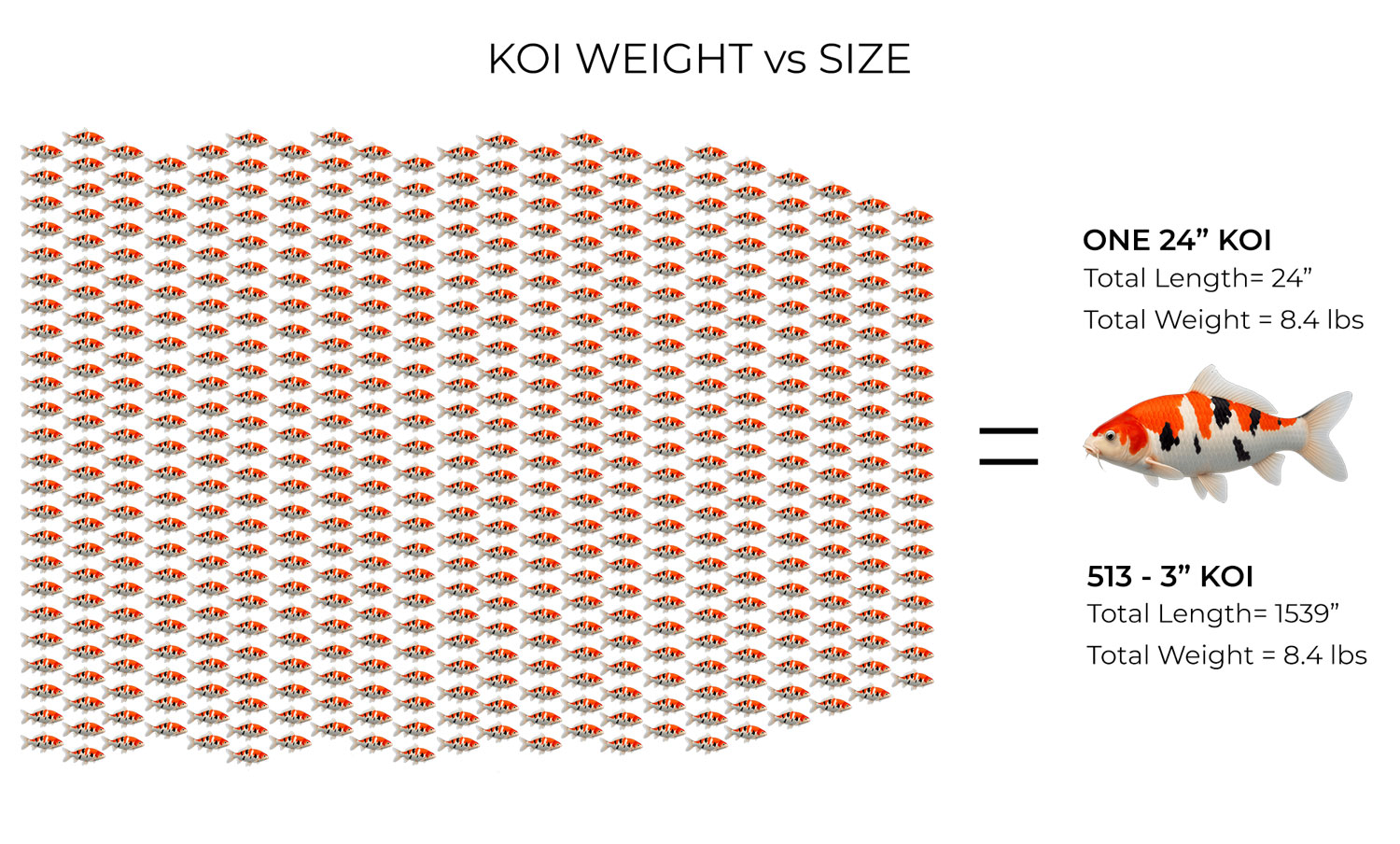
Here is where stocking levels and fish size actually makes a big difference in ponds. The amount of waste a fish produces is based on it’s weight. Koi or goldfish typically produce about 1/3 of their body weight in waste per day. This fish waste, particularly elevated levels of ammonia is often stresses the fish enough to trigger problems like disease outbreak and even death.
Let’s compare the waste produced by our koi from above.
Your pond filter processes this waste both mechanically by trapping solid waste and biologically by housing beneficial bacteria that convert toxic ammonia into nitrate. The bigger your filter is (the more surface area it has) the more waste it can handle.
So even, if you have a large pond with lots of volume to dilute the waste produced by the fish, if you don’t have an adequate filter to break down and remove the waste, their levels will eventually rise high enough to cause water quality issues.
The short answer to how many fish can I have in my pond is 1″ of fish / 10 gallons of pond water.
If the average pond owner that has smaller fish like goldfish follows this rule, they won’t have to spend an excessive amount of time maintaining filters or monitoring water quality etc.
On the other hand, pond hobbyists and koi enthusiast that keep large koi and follow this rule, they will have to deal with substantially more waste. They will need to spend more time monitoring and maintaining their pond. Ideally, they should invest in better filtration systems, monitor water quality regularly and perform regular partial water changes etc. to maintain optimal conditions for their koi.