If you have just purchased a water lily, it likely came in a very small pot which is far too small for it. Or maybe a friend split one of their large water lilies and gave you a piece of the tuber. Now what? If you would like to know how to plant a water lily properly follow the steps below.

If you want your water lilies to really grow well and produce a profusion of blooms, you need to plant them properly. Tropical and hardy water lilies are heavy feeders, they produce the new leaves and flowers all summer long which requires an abundance of nutrients. Proper pot size, planting medium and fertilizer are the key ingredients to a healthy, beautiful water lily.
Always choose as large a pot or container as possible, pots that are too small will stunt the growth of the plant and result in fewer leaves and blooms. A large pot will provide plenty of room for the roots of the water lily to absorb nutrients and grow vigorously. Large varieties of water lilies should be planted into pots at least 12” in diameter. Small or dwarf varieties of water lilies can be planted in smaller containers, usually 8” diameter is sufficient. Flexible Aquatic Planters come in a variety of sizes and are a very good choice for planting water lilies and marginal pond plants.
It is best to choose a heavy soil, pure clay or a mixture of clay topsoil will be fine. We have found Aquascape Planting Media an excellent choice. Some people choose pot their water lilies entirely in pea gravel. While it will allow the lily to root properly, it is not a good choice because it will allow fertilizer to leach into the pond water possibly causing an algae bloom.
As mentioned above, water lilies are heavy feeders and should be fertilized early in the spring as soon as the first few leaves reach the surface of the water. There are several types of aquatic plant fertilizers available. All fertilizers are graded on a 3 number system ie. 20-20-20, usually, this number is prominently printed on the label. These 3 numbers stand for the proportion (in order) of Nitrogen, Phosphorus and Potassium. No matter which type of aquatic plant fertilizer you choose, pick a fertilizer with a higher middle number (phosphorus). Phosphorus is important in root and bud formation and promotes large beautiful flowers. Tablets are the most commonly available pond plant fertilizer. Although they provide good results, they typically last about a month and need to be reapplied to the pot throughout the summer. We have found Thrive Aquatic Plant Fertilizer gives the excellent results for water lilies and marginal plants. thrive has a 10-14-8 formulation to provide strong growth, while promoting excellent blooming for flowering plants. You can apply Thrive tabs once per month during the growing season, however, if you want to maximize the number of blooms, you can fertilize every 2 weeks once the water temperature is over 75F.
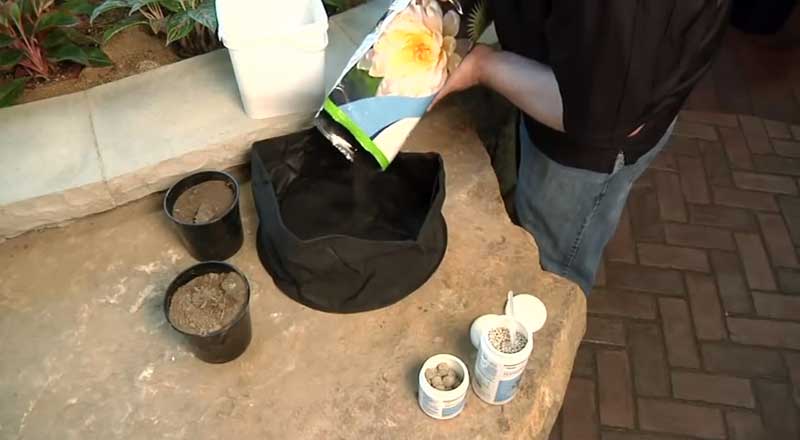
1. Start by filling the bottom 1/3 of the pot with aquatic soil and pack it down tightly.
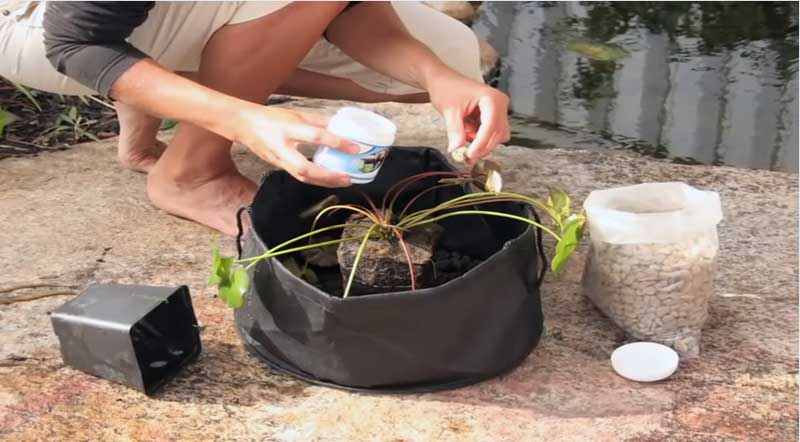
2. Place the roots of the water lily gently in the bottom of the pot. Position the water lily tuber at one edge of the pot with the growing tip aiming towards the center of the pot and pointing upwards at an angle towards of about 45 degrees. This will allow the lily to grow ‘into’ the pot. The growing tip of the water lily should be about even with final level of the soil in the pot.
3. Now add some fertilizer. Thrive Aquatic Plant Fertilizer has the proper formulation promote lots of blooms and excellent growth. The number of tablets you add depends on the size of the pot, follow the directions on the label for proper usage.
4. Fill the pot a bit more than ¾ full with soil and pack it down tightly. Be careful not to damage the plant roots, leaves or growing tip.
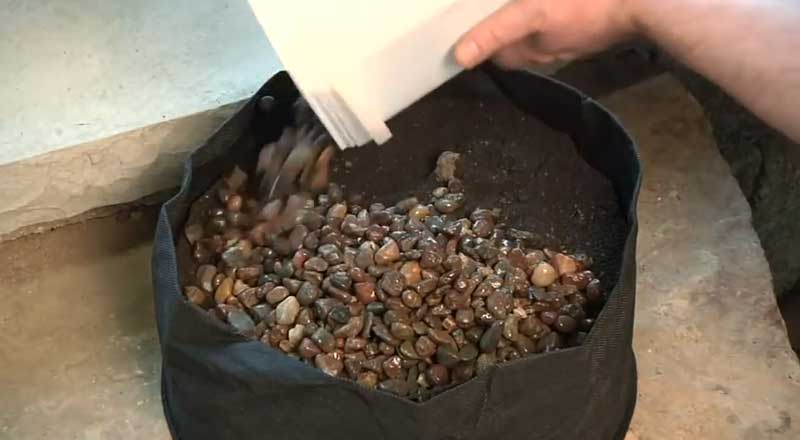
5. Fill the remainder of the pot with gravel. Gravel helps to prevent fish from digging in the soil and clouding the pond water. If you have only small fish, pea gravel will work fine. If you have larger fish, use larger gravel or even river rock to prevent the fish from digging in the pot and uprooting the water lily.
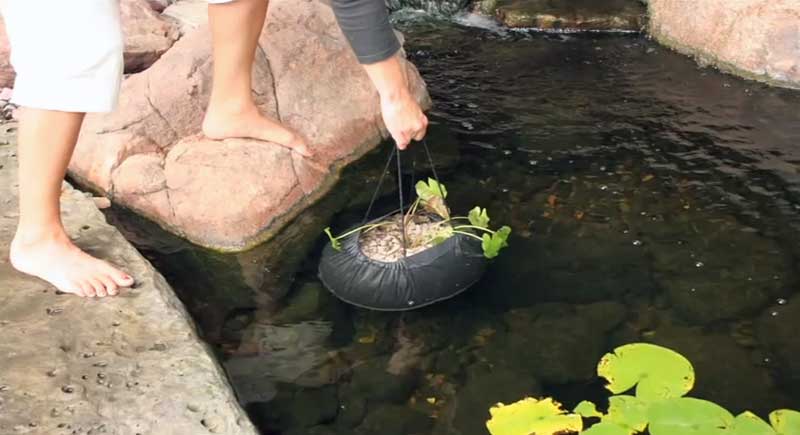
6. Finally, add the pot to the pond by slowly sinking into the water just until the water level is even with the top of the pot. Wait a minute or two to allow any air pockets inside the soil to escape, then set the pot in its final position in the pond. Water lilies do best when placed between 18″ and 30″ deep in the pond, where they will receive a minimum of 4 – 6 hours of sunlight a day.